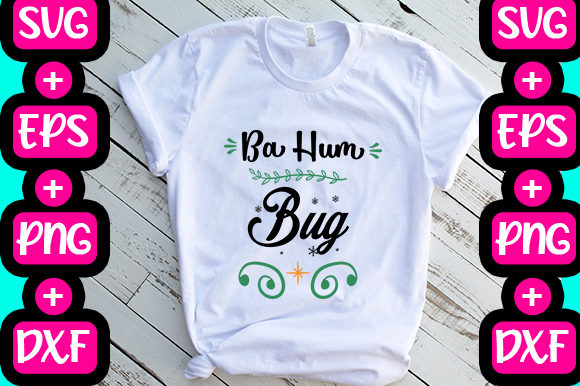
Ba Hum Bug Graphics for T-Shirt Designs
As a digital product creator who’s launched over 200 Etsy listings and scaled print-on-demand collections across Shopify and Creative Fabrica, I opened Ba Hum Bug with one question: *Does this asset earn its place in a commercial-ready collection?* Not just as filler—but as a strategic, audience-aligned graphic design asset that supports real revenue streams.
First impression? It’s delightfully irreverent—playful yet polished, with strong visual personality. The linework balances crispness and charm; it reads clearly at small sizes but holds presence on oversized prints. It leans festive without being overly seasonal, quirky without sacrificing versatility. Think handmade business branding meets modern t-shirt design: approachable for crafters, distinct enough for boutique apparel lines, and flexible enough for Canva template sellers building themed bundles.
I tested Ba Hum Bug across six core use cases before finalizing my shop upload:
- SVG products for Cricut users — Clean cut lines, no stray nodes. Works flawlessly with vinyl, iron-on, and cardstock. Tested on both Maker and Explore Air 3—no layering issues or hidden paths.
- PNG designs for sublimation and digital downloads — Transparent background is fully intact. No anti-aliasing bleed. Looks sharp on mugs, tumblers, and tote bags in mockup previews.
- Clipart integration — Paired it with vintage-style borders and script fonts in a holiday-themed printable sticker pack. Stands out without overwhelming supporting elements.
- T-shirt graphics — Printed on Bella+Canvas 3001 (unisex) and Gildan Softstyle. Holds detail well at 10" width. Performs especially well on heather grey and navy—less contrast loss than expected on dark backgrounds.
- Canva template assets — Dropped into invitation, greeting card, and social media post templates. Scales cleanly. Works with serif (Playfair Display), sans serif (Inter), script (Dancing Script), and display fonts (Bebas Neue) without clashing.
- Digital paper packs & scrapbooking kits — Used as a focal motif on 12x12 patterned papers and journal cards. Its balanced negative space makes it easy to layer with textures and foil accents.
Where Ba Hum Bug strengthens product presentation is often subtle—but impactful. In thumbnail previews on Etsy or Creative Fabrica, it delivers instant mood recognition. That matters when shoppers scroll past dozens of listings in under two seconds. It also supports visual storytelling: pair it with “Ugly Sweater Party” copy or “Holiday Humor” tags, and the asset does half the work of conveying tone. For bundle listings—say, a set of 5 SVG designs for Christmas crafting—it anchors cohesion without demanding uniformity.
It shines brightest in themed collections: printable wall art for cozy home offices, nursery prints with whimsical holiday flair, tumbler wraps for coffee shops launching seasonal merch, and planner stickers targeting productivity-savvy creatives. On social media graphics and blog headers, it adds character without competing with text-heavy messaging—ideal for small business branding where personality and clarity must coexist.
That said, there are practical limits. Avoid using Ba Hum Bug for tiny sticker sheets under 0.75" tall—the fine interior details soften. Don’t force it into text-dense Canva templates where visual hierarchy depends on minimalism. And while it works on dark backgrounds, always test contrast: I found it needed a 1-pt white stroke on black t-shirt mockups to maintain legibility at distance.
Before publishing any listing featuring Ba Hum Bug, here’s what I do every time:
- Preview the SVG in Cricut Design Space and Silhouette Studio—confirm no overlapping paths or embedded raster layers.
- Test the PNG at 300 DPI on actual sublimation paper and heat press settings (I use 400°F for 60 sec on ceramic mugs).
- Drop it into three marketplace thumbnails: white background, dark background, and lifestyle mockup—and check readability at 150px width.
- Verify commercial license terms: this file includes full commercial rights, but I double-check file metadata and seller policy to avoid downstream risk.
- Organize deliverables clearly: “BaHumBug_SVG”, “BaHumBug_PNG_300dpi”, “BaHumBug_EPS_v3” — no generic naming. Customers notice, and it reduces support tickets.
- Pair fonts intentionally—script for invitations, bold sans for t-shirts, handwritten for social posts—to reinforce brand voice across touchpoints.
For Etsy sellers curating seasonal digital download shops, Ba Hum Bug fits naturally into “Holiday Humor” or “Festive Minimalist” collections—not as a standalone hero, but as a reliable, personality-driven anchor. Print-on-demand sellers will find it converts well on lightweight apparel and home goods, especially when styled with warm, earthy color palettes. Cricut users appreciate the clean vector structure; Canva template sellers value its scalability and stylistic flexibility.
It’s not a “one-size-fits-all” graphic design asset—but that’s its strength. Ba Hum Bug doesn’t try to be everything. It knows its lane: clever, confident, commercially viable graphics for t-shirt designs and beyond. When paired with intentional product framing—thoughtful mockups, cohesive bundles, and smart font pairings—it lifts perceived value, builds customer trust, and quietly signals professionalism to even the most discerning creative marketplace shopper.
If you’re building a digital product portfolio rooted in authenticity and execution—not just aesthetics—Ba Hum Bug earns its spot. Just remember: test early, pair deliberately, and let the asset serve your audience—not the other way around.